Music and Seniors
At the Happy Music Center, we advocate for the use of Happy Music for its beneficial impact on health. We invite you to explore the following articles/videos to witness the profound role music plays in addressing various health and wellbeing concerns.
What a difference Music will make in a life and thanks to those who share it! Graham Nash and Joni Mitchell

They loved each other deeply, lived together, and wrote songs for one another. But by 1970, their romance ended. They went their own ways, married other people, and lived very different lives.
Decades passed with almost no contact between them.
They built separate families, created distinct musical paths, and allowed time to build a long, quiet distance.
To anyone looking on, their sweet young romance was merely a distant memory, a brief chapter written in the golden light of their youth and left far behind in another era.
This was the story of music legends Joni Mitchell and Graham Nash. In the late 1960s, they shared a famous bond in California, inspiring legendary music that captured the gentle magic of their time together. But life carried them in opposite directions.
For forty-five years, they built separate lives, focused on their careers, and continuously moved forward.
It seemed their story had long since concluded.
Then everything changed in 2015, when Joni suffered a devastating brain aneurysm in her home.
The medical emergency was catastrophic, suddenly taking away her ability to walk, speak, and play the guitar. For a woman who had spent her entire existence expressing her heart through music, it was a heartbreaking loss.
She found herself trapped inside her own body, facing a long and lonely road toward recovery.
When Graham heard the heartbreaking news, he did not settle for sending a simple sympathy card or placing a quick, polite phone call from afar. He chose to show up in person.
“When someone who changed your life is hurting, you do not just send flowers,” Graham explained when talking about that emotional period.
“You go to them, and you stay until they are okay.”
Graham visited her regularly during her long and painful rehabilitation. He stayed by her side through the most difficult moments of recovery, offering constant encouragement.
He took on the patient task of helping her relearn how to play the guitar.
Together, they slowly revisited her famous songs, working through them note by note and word by word.
“Let us try that chord again, slowly,” Graham would whisper gently when her hands hesitated over the fretboard. “Your fingers remember the music, Joni. We just have to remind them together.”
He spent countless hours helping her patiently rebuild the creative life that illness had threatened to steal away. They did not get back together as a couple.
They were both much older, their personal lives had changed dramatically, and too many years had passed for them to restart a traditional love story.
But a romantic reunion was never the reason for his visits.
Graham once explained the depth of his feelings by saying, “I loved her when we were twenty-seven, and I love her still at seventy-five, even if that love looks completely different now.”
His actions were never driven by passion, vanity, or a desire for public praise. It was a pure act of devotion.
He simply wanted to be present for someone who had been so meaningful to him, asking for nothing in return and seeking no attention from the world.
He did it quietly, faithfully, and steadily.
This extraordinary story shows us that real love does not always mean staying together forever in a traditional relationship.
Sometimes, true love is simply choosing to be present when things get extremely hard. It means being the loyal person who refuses to let an old friend face their darkest moments alone.
Graham Nash returned to Joni Mitchell’s side exactly when she needed him most.
Seeing Joni reclaim her life and return to the music she loves is a miracle that touches millions, but for Graham, it was always personal. He came back not for the legend, but for the girl who once shared a home and a song with him all those years ago.
Their story leaves us with a simple, beautiful truth: love isn’t about holding on forever, but about reaching out your hand the very second someone you care about starts to fall.
>We Are Human Angels<
Authors
Awakening the Human Spirit
We are the authors of ‘We Are Human Angels,’ the book that has spread a new vision of the human experience and has been spontaneously translated into 14 languages by readers.
We hope our writing sparks something in you!
WWII veteran, 100, celebrates milestone birthday by playing drums, reveals secrets to longevity
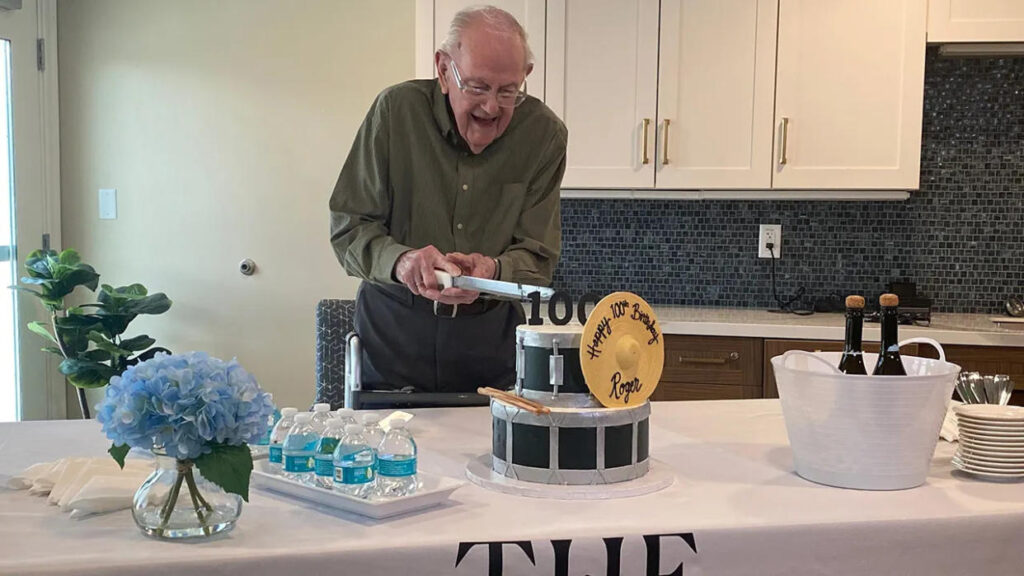
A World War II veteran and musician from Massachusetts recently celebrated his 100th birthday by hosting a concert for his family and friends.
“Music is in everyone and everything,” Roger Wonson, a drummer, saxophone player and retired engineer who lives in Beverly, told Fox News Digital.
“I think I would’ve been a completely different person if I’d never been into music,” he said. “It taught me how to listen and, in some ways, even how to feel.”
Wonson said music has not only been a big part of his life, but his family’s lives as well.
“It’s funny because when I was five years old — in the 1920s — I was given a player saxophone,” Wonson said.
“It was the roaring twenties, and the player saxophone was invented in around ’24,” he added. “It was like the player piano with the roll paper. It was very popular. It had a crank, and you blew into it — and it played.”
People in the community noticed the five-year-old sax player — and his musical career took off, Wonson said.
“They named me the ‘Rudy Vallée Junior,’” Wonson said.
“Here I was five years old, cranking this thing and playing chords and the melody, and people got a big laugh about it. Then, I looked down into the orchestra pit and I saw a real saxophone. And I’ll never forget that. I said, ‘That is something.’”
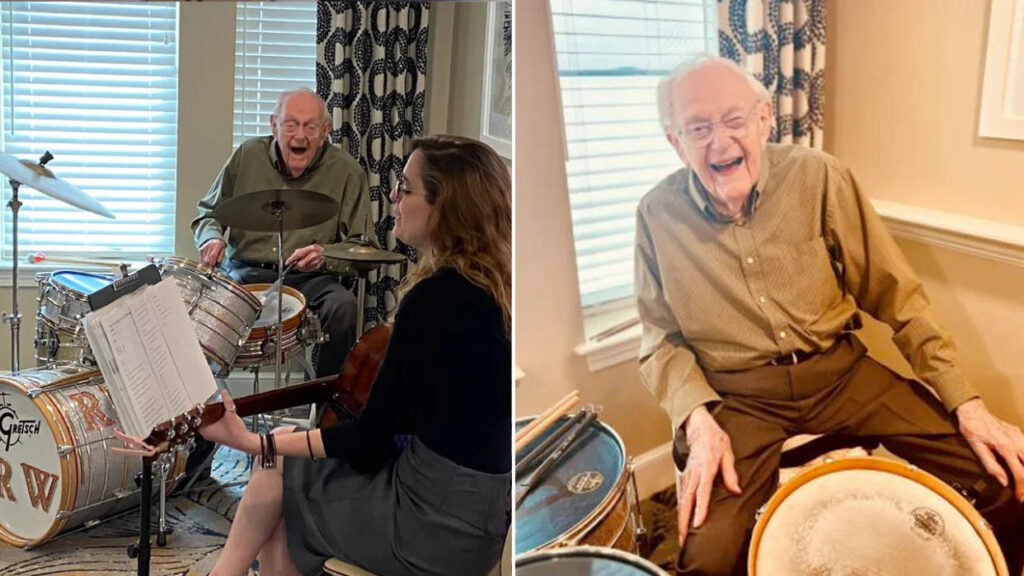
Wonson said he took to the drums a few years later when his older brother left behind a drum set after moving away from home.
He recalled listening to all sorts of big band music on a Victrola while sitting in the attic of his childhood home in Essex, Massachusetts.
Wonson said he remembers his home phone number was 37.
“When I was in the service and I would call home, I would call Essex, Massachusetts 37,” he said with a laugh. “The operator would say, ‘Well, the Wonsons are not there today.’ … It was really a personal operator in those days.”
After the war, Wonson took advantage of the GI Bill and enrolled in the Capital Radio Engineering Institute (now Capitol Technology University) in Washington D.C. He was hired as an associate engineer at Raytheon and spent 40 years at the company, retiring as a senior engineering specialist.
“I had a wonderful career,” he said. “Raytheon was the first company to produce the transistor. It was invented by Bell Labs, and I worked all through that. There were unbelievable changes in my time. The digital revolution is astounding in every discipline. I loved every minute of it.”
Throughout Wonson’s highly technical career, music continued to play a role — and when he retired, he played the saxophone and the drums in an 18-piece swing band for about 25 years.
His band played in various venues, including retirement homes such as the one where he lives today.
“It is such a win-win when you are playing and the people are smiling and join with the music, whether it’s a big or a small gig,” Wonson said.
Michelle Boudreau, program director at The Current Beverly, where Wonson resides, said his musical presence is a gift to the community.
“You step outside and even the birds and the trees make music … All I can say is, it’s important for everyone, whether they think so or not,” he said.
Using music to help unlock Alzheimer’s patients’ memories
Music and Depression, “A Long Way Home” by HMC Ambassador, Angelo Paul Ramunni
The Long Way Home…. February 7, 2026
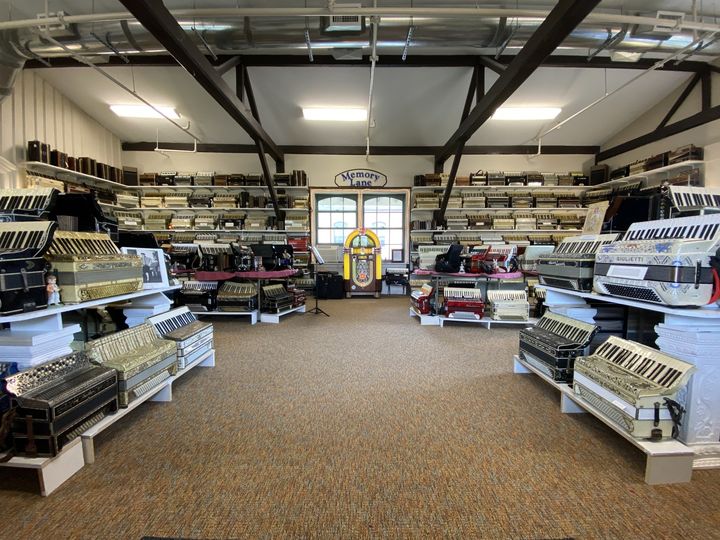
Having the position of being a museum curator and collector of accordions for the last 17 years, has connected me with numerous folks who have taken interesting paths in their pursuit of music and life. I try to pass these stories along to all of you in the hope that they will be a benefit to you and serve as a guide and reference point for success in your own musical journey. The following story is a serious one, but it has, I think, a happy ending.
I met Ted while in Catholic grammar school. He was a couple of years younger than me, but we had something in common…the accordion. We were taking lessons from the same teacher and even played for our classes and the nuns at school. We stayed in touch over the years with Ted moving on to playing the guitar and soon thereafter he found his true love in a set of drums. He was very good with those drums, so good that he found himself on stage with a band at Woodstock in 1969. They played for the crowd between the big-name singers and rock bands.
I lost touch with Ted somewhere along the way, but he suddenly surfaced some years ago when I started our accordion museum. His story, I’m afraid, is all too common. He bought into the 60’s hard rock lifestyle 100%. As he would say, “I did it all, from the early days in the1950’s of booze, butts and broads, into the 1960’s and beyond when we did whatever we wanted and whenever the urge hit us.”
But more recently, I was surprised to hear that he was back to playing his original accordion. And he also told me that he came back to his faith. Jesus Christ was now in his life. He had been with quite a few women over the years and never settled down with anyone in particular. But he told me about someone he had stayed with for a while and then very suddenly, she left him. He happened to meet her again sometime later. To his great shock and regret, she told him that she left him to have an abortion and that it was most probably his child. That stunned and hurt Ted enormously, and he fell into a time of deep depression.
He credits the accordion music as it was a great help to him in coming out of his depression. It not only brought him back to a more sensible and simpler time in his life, but he felt that the songs and the music itself had a palpable effect on his recovery. By making music again, he also noted that the process of recovery rested, to a certain extent, literally in his own hands. However, it was his desire to someday see his child that brought him to his knees before God.
Ted’s gone now. But he sent me a few short messages before he passed, and he referenced Matthew chapter 25 in the Bible. He felt strongly that this piece of Scripture is the true roadmap for getting home. I think he was right, and I would like to think he made it home.
If you look at the actual words of Christ in Matthew chapter 25, you’ll see that it is Jesus’ final teaching to us before His death and resurrection. He is preparing His disciples for the long stretch of history before His return.
The more I talk to people like Ted about their experiences with the accordion, the more I believe there is something extremely unusual, beneficial and other worldly about its sound.
Walter S Landor, the English poet, once wrote: “Music is God’s gift to man, the only art of Heaven given to earth, the only art of earth we take to Heaven.”
It may have been the long way home, but I’m very certain Ted made it.
Paul Ramunni
New England Accordion Connection & Museum Co.
NEACMC.com
860-833-1374
Music rejuvenates the culture, history and memories of dementia patients
Candy Cohn used to always speak with her mother, Lillian Cohn, in English, with a few words here and there in Yiddish.
Then one day, Lillian, of Delray Beach, started singing a beautiful Yiddish love song called Sheyn Vi Di Levone.
“I’d never heard her sing it. I never heard her play it. The look on her face and the joy. I hadn’t seen that in her in a long time,” Candy Cohn recalled in an interview with WLRN in talking about her mother, who passed away in 2022.
The song’s title means beautiful as the moon. Cohn started regularly playing a video of actress and performer Lisa Fishman singing this song. She didn’t expect the music to tap into a memory bank her mom still had.
“It brought back so many memories for her,” said Cohn, who owns Oasis Senior Advisors South Florida, which helps families find housing for older loved ones. “She started telling me how she first heard it, what she was doing, and when she would sing it.”
READ MORE: Planning ahead for Alzheimer’s costs in Florida is key
Medical experts have explored how music can activate memory for years. Neurologists explain that episodes of our lives first get filed away in an inner region of the brain called the hippocampus. Over time, memories get stored for the long term in the outer layer of the brain, which is the cerebral cortex.
“Even in a person with Alzheimer’s whose hippocampus has been destroyed, those older memories are still able to survive in the cortex,” said Dr. Andrew Budson, who studies the science of memory. He works as the chief of cognitive and behavioral neurology at the Veterans Affairs Boston Health Care System and is a neurology professor at Boston University.
A song can get encoded in the brain, or consolidated, with an episode of one’s life, like a time and place. That’s called episodic memory. Learning the lyrics and the melody of a song becomes part of semantic memory, which is the general knowledge, like facts, that we accumulate over time.
“You get this sort of resilient memory that is well preserved in the cortex, that is still linked to an episode of someone’s life. It’s a semantic memory linked into an episodic memory, and so we can use the semantic memory, whether it’s the music or the language, to pull the episodic memory out.”
What’s more, when we tap our feet, clap our hands, and nod our heads to a song, that activates the body’s motor system… and procedural memory.
The combination of episodic, semantic, and procedural memories can make memory more resilient.
“Maybe we could use [music] as a tool to help people remember better,” Budson said. “The main thing my lab is interested in is can we find tools and techniques and habits that people can use to help them remember things better, to allow them to live more independently in their own homes for a longer period of time.”
Music as therapy
Tino Negri has seen the results of music therapy for many people with dementia. He’s an owner of a company in South Florida called ComForCare, which provides respite for caregivers. He’s also done a lot of volunteer work at community centers across this region, bringing interactive music programs to residents with memory disorders.
“Music is the one thing that opens up people’s brains, and it helps fire off neurons on both hemispheres of the brain,” he said — pointing to serotonin, which helps our mood, dopamine, a neurotransmitter involved in learning and emotion, and endorphins, which reduce stress and pain. “These are chemicals that make people happy.”
Negri urges caregivers to play music at home, but not just any songs. Rather, those that are tailored to their loved ones. What they loved or moved them in their youth.
“Yiddish is known as ‘mame loshn,’ which means mother’s tongue. It’s a language that touches into culture, into religion, into one’s history.”
Dr Marc Agronin, geriatric psychiatrist.
Long-term memories are still accessible long into a disease like Alzheimer’s, and can be sources of comfort for people, said Dr. Marc Agronin, a geriatric psychiatrist and the chief medical officer for the MIND Institute of Miami Jewish Health.
“Yiddish is known as mame loshn, which means mother’s tongue,” Agronin said. “It’s a language that touches into culture, into religion, into one’s history.”
Agronin said when music moves a person, it involves the entire brain.
He has been moved to see “someone who otherwise might be somewhat withdrawn and really experiencing significant short-term memory deficits, literally come alive when you play music that touches into them,” said Agronin, who recommends personalized programs like the Miami-based Mind & Melody.
Treatment has to be individualized because different music works for different people. “Someone who grew up with Yiddish music, this might be something that really inspires them, but I’ve worked with patients from all over the world, and I’ve been exposed to so many different types of music that they love,” Agronin said, like music from Cuba and India. “It’s wonderful when you see someone really almost appear rejuvenated by the music.”
Remembering the past with song
Actor Avi Hoffman and his mother, Miriam Hoffman, a renowned Yiddish expert, are passionate about speaking in and teaching the language.
George Schiavone
Actor Avi Hoffman and his mother, Miriam Hoffman, a renowned Yiddish expert, are passionate about speaking in and teaching the language.
Miriam Hoffman is a renowned Yiddish author, playwright and former journalist who taught the language for nearly three decades at Columbia University.
On a recent morning in her Coral Springs apartment, she sang an array of songs in Yiddish, reciting the precise lyrics without missing a single word from the lyrics.
She sang along with her son, Avi Hoffman, a famed actor. They sang songs like Oyfn Veg Shteyt A Boym, which means “on the road stands a tree,” and Oyfn Pripetshik, meaning “in the fireplace.”
The tunes date back decades and harken to memories of her childhood as a young Jewish girl growing up first in Russia, then Poland, Austria and Germany before moving to New York.
“I am always amazed at how readily my mother’s memories are clearer when we speak or listen to her beloved Yiddish language and music.”
Avi Hoffman, whose mother is a diagnosed with a disease linked with dementia.
What’s striking about her ability to recall these songs, says her son, Avi Hoffman, who is a famed actor, is that his mother was diagnosed nearly five years ago with white matter disease, which is linked to dementia. Sometimes she needs help recalling some details about her life — except when speaking in Yiddish.
“It comes so natural that I don’t even think to speak Yiddish. It just flows,” Miriam Hoffman told WLRN.
To remember events of the past in English, though, she sometimes needs a little help from her son.
He has made more than 200 videos on YouTube, in Yiddish and English, through a nonprofit dedicated to spreading the love for the language that the Hoffmans co-founded, called Yiddishkayt Initiative. Avi Hoffman says these are especially helpful for people who spoke the language in childhood and might be at home without fellow Yiddish speakers.
“I am always amazed at how readily my mother’s memories are clearer when we speak or listen to her beloved Yiddish language and music,” Avi Hoffman said.
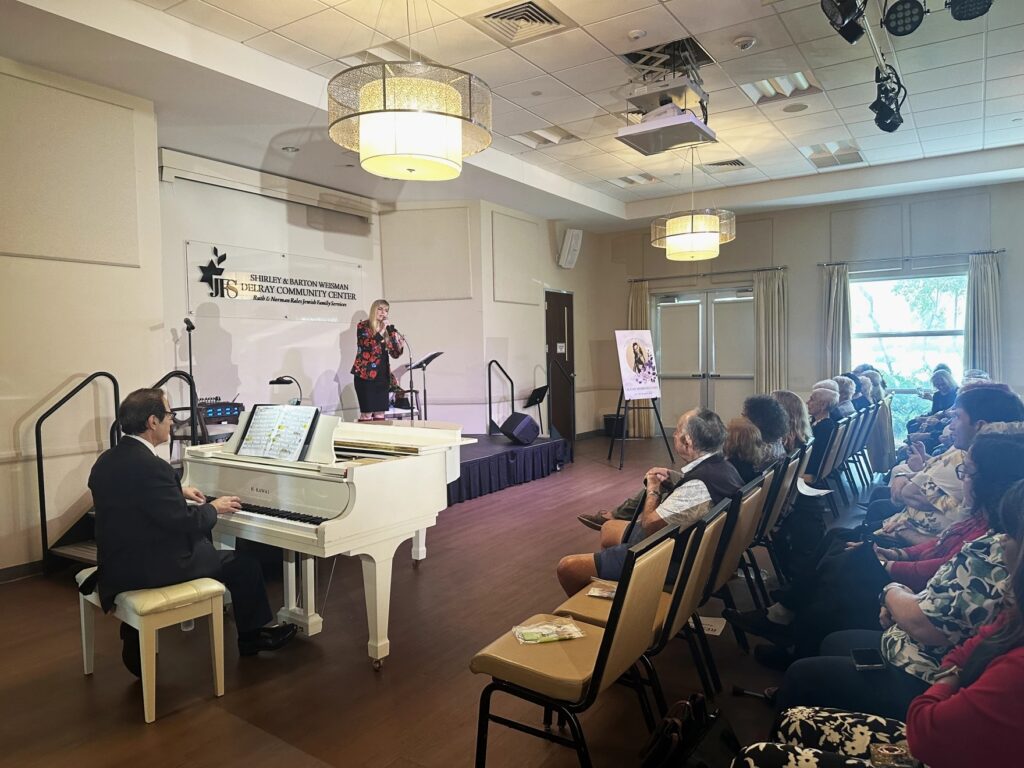
Having witnessed that joy herself with her mother, Candy Cohn decided to sponsor a Yiddish concert in Delray Beach in February. Lisa Fishman, the singer in the video Cohn used to play for her mother, was in town from Los Angeles and came to perform at the Weisman Delray Community Center.
The concert had a waitlist of people wanting to get in. Cohn said she plans to sponsor more to bring more joy, especially for people who have dementia.
Alice Grandon and a Lifetime of Accordion Music
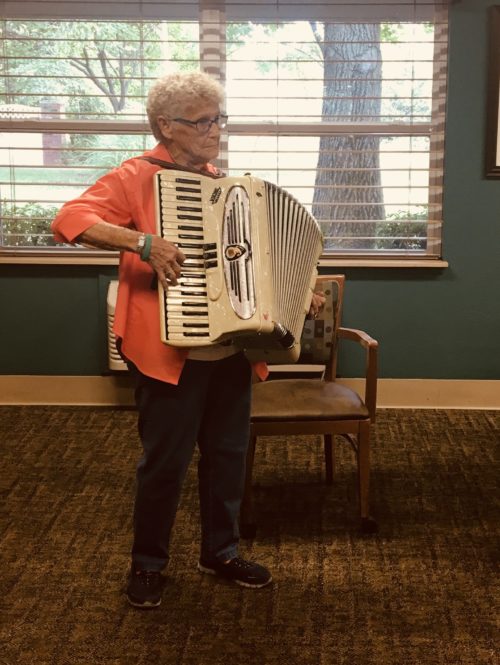
Alice Grandon has been playing the accordion for 77 years, since the age of 7. She has played in bands and orchestras and at parades and nursing homes and hospitals. She’s played for people of all ages, from children to adults age 100+. She plays for everyone – and it does not take long to see the impact she has made.
Grandon’s musical journey began in 1939 with a tough decision. Her parents had to decide between buying a car for the family or an accordion for Alice. Deciding on the accordion, Grandon’s mother had to hand-carry the heavy case from 101st and Holmes in Kansas City all the way back to 85th Street, just so Alice could start getting to her accordion lessons in Martin City every week.
Young Alice Grandon took accordion lessons for just about a year and a half, renting an accordion for three months at a time so she could progress to a bigger instrument as she grew. After this brief formal music education, Grandon continued to teach herself to play by ear, learning mostly by playing for others and “keeping it going every day.”
Grandon’s musical forays continued into adulthood with a job at the music store in Paola, where one perk was learning more about music. That job also got her the commissions that allowed her to get her first TV in 1952, not long after getting married and having a baby. Music and life, always intertwined.
Ask the MD: Music Therapy and Parkinson’s
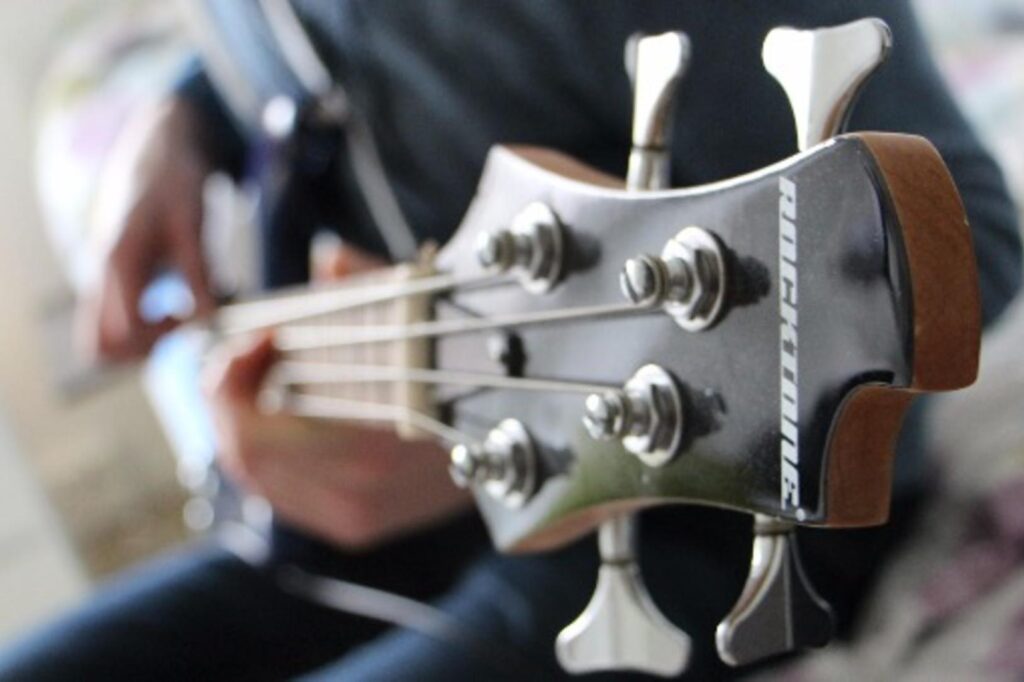
Music is a powerful tool that can ease many symptoms of Parkinson’s disease, such as walking, speech and mood changes.
Music moves us, emotionally and physically. And it can be a powerful tool to ease many symptoms of Parkinson’s. To learn more about music, the brain and Parkinson’s, we spoke with Kerry Devlin, MMT, LPMT, MT-BC, senior music therapist at Johns Hopkins Center for Music and Medicine in Baltimore, Maryland.
The Michael J. Fox Foundation (MJFF): Let’s start broadly. How does music affect our brains?
Kerry Devlin (KD): This is something that is still being researched. But we know that music stimulates many brain areas and processes — our thinking, memory, feeling, moving and other processes. And it does this whether the brain has disease or not. When there is disease, music can bypass faulty pathways to lessen symptoms.
The brain synchronizes to music. This is called entrainment. An example is when you start tapping your foot and only then hear a song playing. Your brain was aware of the music and started moving your body without you realizing it.
MJFF: How can music help people with Parkinson’s?
KD: Music can impact many Parkinson’s symptoms. The three areas that are best researched include motor, speech and voice, and psychosocial (thought and behavior) symptoms.
Many people with Parkinson’s have walking problems. These might be difficulty starting, suddenly stopping or freezing, or festination. These symptoms can be frustrating, unsafe and lead to falls. To help, we can use specific types of music, called rhythmic auditory stimulation. This involves using a metronome or live music to help a person move faster or slower, overcome freezing, or change gait patterns.
A lot of people also experience speech and voice symptoms. Singing is a way to improve loudness and clarity as well as quality of life, helping people better communicate with care partners and loved ones. Singing in a group also is a social experience, a means of connecting with others who share your experience.
Mood changes are common in Parkinson’s, too. Music therapy can create a space where you can process the impact of a Parkinson’s diagnosis on your life or ease anxiety. It also can be a way to connect with loved ones or leave a legacy. You can write a song for your spouse or children, tell your life story through songs, or dedicate songs to important people in your life.
MJFF: What, exactly, is music therapy?
KD: It’s using music as a therapeutic tool to meet your personal clinical goals. Music therapists are members of the multidisciplinary care team, and work in partnership with you and your other providers to support the needs that are most important to you. It’s collaborative, creative, and evidence-based.
Like physical, occupational or talk therapists, music therapists are certified and credentialed. They are highly trained musicians who can help you use music to manage symptoms.
MJFF: What’s a typical music therapy visit like?
KD: Music therapy can take different shapes and forms, depending on what you want to work on and your therapist’s approach. In your first meeting, the therapist will learn what brought you to music therapy and what your goals are. They may review your medical chart or, with your consent, talk with other members of your health care team. They’ll share what they can offer and potential directions you can take, together, to reach your goals. Activities might include moving to music, singing a favorite song and talking about lyrics, or relaxing to music to ease anxiety. What you do might change as you meet or modify goals.
Music therapists are a unique part of your health care team. They’ll work with your doctor, physical or speech therapist, and other team members to provide the best care possible for your symptoms. This might mean you work one-on-one with a music therapist or that your music therapist helps enhance your physical or speech therapy. I might, for example, play music loudly to cue a person to sing more loudly or have them hold a note longer to work on breath control. Or I might help tailor music to meet physical therapy goals.
MJFF: Who can benefit from music therapy?
KD: Anyone who likes music! And that’s most of us because we all connect with music in one way or another. You don’t need any musical ability or experience. Music therapy can be meaningful to anyone at any point in their journey with Parkinson’s.
MJFF: How can you find a music therapist? What should you look for?
KD: Search online for someone near you. The American Music Therapy Association keeps a database. You can check a therapist’s credentials (MT-BC) through the Certification Board for Music Therapists. Make sure their experience and expertise match your goals. And, as with all health care providers, make sure they’re a good fit for you.
Unfortunately, music therapy isn’t yet covered by insurance. But we’re advocating for this! Cost will vary but your therapist can help you build a program that works for your financial situation.
MJFF: If music therapy isn’t available, can you still use music to treat Parkinson’s?
KD: Yes! My prescription for everyone is to sing along (loudly) to one song each day. It can be any song anywhere. This is especially good before a social function where you expect to talk a lot or in busy spaces. Sing loudly in the car on the way there to get your voice going. Singing, either in your head or out loud, also can be a way to start or regulate walking in Parkinson’s.
Music can boost motivation and magnify the effects of exercise, too. A music therapist can help you find music of different tempos to match different exercises.
And you can use music to manage emotions. Make playlists that help you feel calm or energized. Or use music to ground yourself and be mindful. In the hustle and bustle of managing medical care, going to appointments and more, we can forget to stop and focus on ourselves. Turn on a song that feels relaxing, close your eyes if that’s comfortable, and focus on your breath for a minute or less. Then check in with yourself and how you feel.
If you want a more structured experience, look for community programs (many of which are free or lower cost), like in-person or online singing groups, or dance or other music classes. Examples include the Parkinsonics choir and a drumming class, both of which meet via Zoom.
The Healing Power of Music: Robin Spielberg
AMTA-Spokesperson, Robin Spielberg, beautifully portrays the importance of music and the value of music therapy in today’s society. Her ideas about music are easily understood by the general public; she carefully comments on music while promoting the powerful and significant work of professional music therapists. Robin is an excellent storyteller and, by using the example of her premature infant daughter who is now a teen-aged percussionist, she elevates the role music played in the health and development of her daughter and how Robin’s quest to learn about music therapy research led her to a partnership with the American Music Therapy Association. Take a break from your busy day and listen to her compelling story.
Power Of Music On The Brain | Dementia & Parkinson’s
Music significantly boosts senior health, with 98% of adults aged 50-80 reporting benefits like reduced stress (75%), improved mood (65%), and increased motivation (60%). It enhances cognitive function, eases dementia symptoms, fosters social connection, and improves physical health by lowering blood pressure and enhancing movement.
Power Of Music On The Brain | Dementia & Parkinson’s